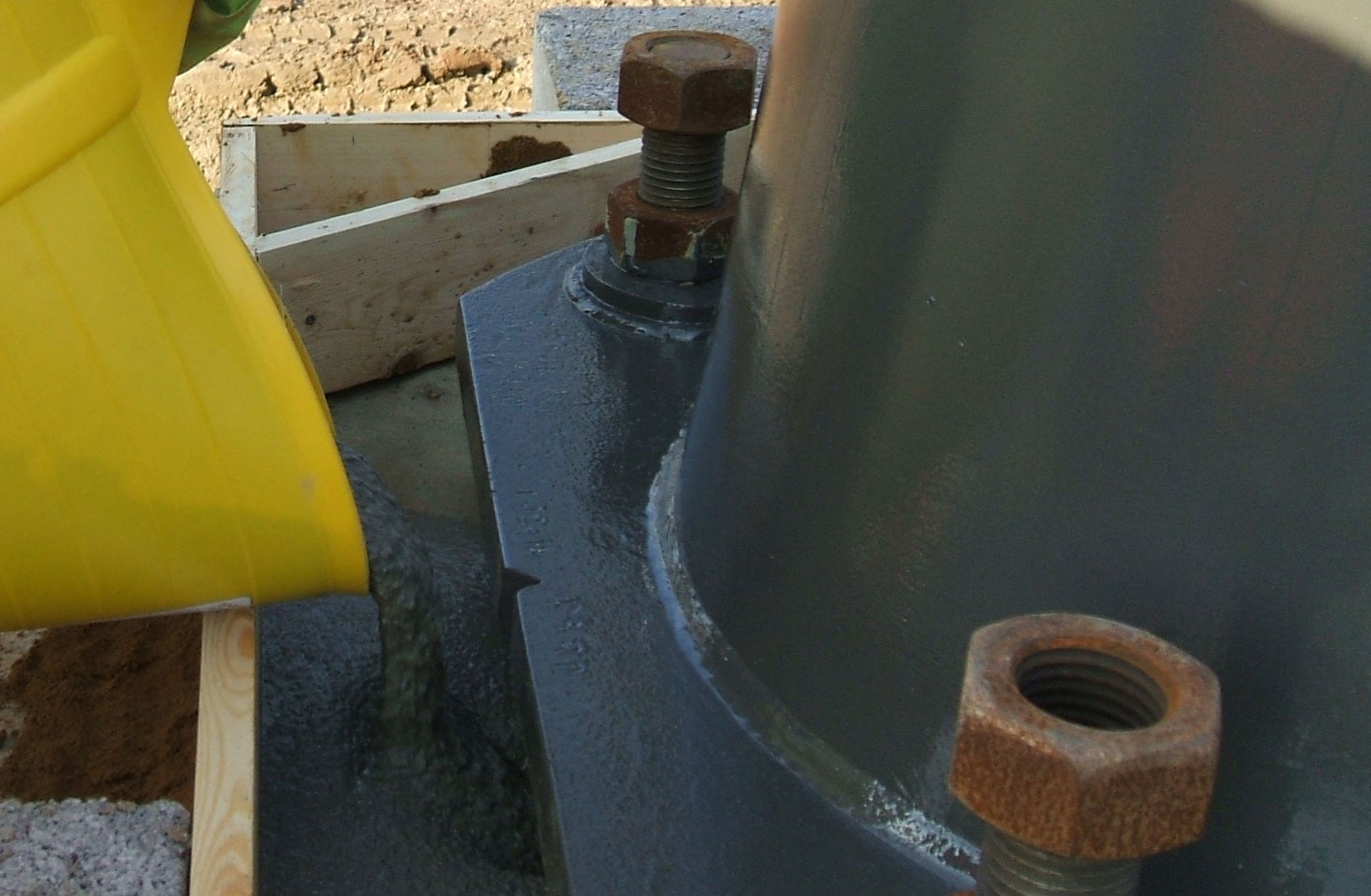
Through decades of experience, we have seen certain problems reoccur indicating that better education in the industry is required. Precision grouting issues can be split into two areas… those that occur during the installation, and those that materialise after the grout has cured, but problems with shrinkage probably equal all the other issues put together.
MIND THE GAP! Why should you invest in a precision grout?
When investing in precision equipment it is critical that the CapEx stretches to a suitable precision grout to ensure all unbalanced forces are contained or absorbed into the foundation without excessive movement to the machinery or structure.
Requirements of a precision grout
The main function of a precision grout is the effective transfer of load from the structure or machine to the foundation. To enable this, the grout must provide adequate permanent bearing, be non-shrink, and have sufficient strength to resist any loading imposed upon it.
The most important requirement for a precision grout is for it to have volume change characteristics that result in complete and permanent filling of the space. Plain grout, consisting of cement, aggregate, and water, does not have those characteristics.
Several other properties of the grout such as consistency, strength, chemical resistance, and compatibility with the operating environment are also important. However, these properties are obtained more easily than the necessary volume change characteristics. For most applications, the space between the foundation and the machinery or equipment base can best be filled by pouring a liquid grout into the void. A plain sand/cement grout with this consistency could be placed in the space and may develop adequate strength. However, after placement, this type of grout will lose contact with the plate because of separation and shrinkage. The result will be an incompletely filled space leaving the equipment resting on the shims or other alignment provision. To maintain permanent contact with the plate, a grout must be formulated using special additives within a cementitious or epoxy system. The stability and non-shrink properties of these grouts give a high proven EBA (Effective Bearing Area), which is the area of contact under a bearing plate, free of air bubbles and voids.

Avoiding shrinkage
The reaction of Portland cement with water is known to produce an initial volume shrinkage of between 1-2% of the mixed grout. To combat this, gas generating additives that are designed to give approximately 2.5-3.5% expansion is used, compensating for the shrinkage and giving positive expansion, allowing a high surface bearing area (generally a minimum of 95%) to ensure full transfer of the load when cured. Over-expansion also needs to be controlled as air entering the mix will reduce the performance of the grout.
There are many ways of producing this gas, one of the most common being aluminium powder. However, as can be seen in the graph below, aluminium reacts very quickly, with the effect ceasing long before the grout has set If the grout hasn't reached its initial cure, it will start to shrink back from its maximum volume, leading to issues in achieving the full surface bearing area. As this shrinkage happens voids can form under the bearing area that becomes filled by air. The consequence is a reduction in the surface bearing area, prohibiting the load transfer between the baseplate and the parent concrete, with uneven loads being transferred, leading to potential premature failure of the installation.
The ideal expansion agent produces gas at a steady rate throughout the setting period, regardless of the temperature (within the normal placement range). To solve this issue Weber has developed webercem advanced precision grout, a non-shrink cementitious grout, which contains additives that produces a steady gas release over the full setting period giving the best effective bearing area possible. The steady release of gas through the working life of the grout ensures that the maximum level is reached long after the grout has been placed giving confidence that there will be no air pockets that could cause cracking or a redistribution of load to the EBA.
For more information...
You can find more information on webercem advanced precision grout here.
Weber can provide guidance on the correct choice of precision grout for your installation. If you require any further information or help with a specification for your project, our technical team is available Monday to Friday, 8:30am until 5pm:
Email [email protected]
Call us on 01525 718877