
How to attach render beads: An expert guide

Applying beads with weberend bead adhesive

A sharp, straight edge can transform any rendering project. It’s details like these that set you apart from competitors, helping you to land new projects and ensuring that your work delivers long-lasting results. 

What's the best method for sticking render beads?

There are a few different methods to attach render beads and each have their own pros and cons, but if applied using a weak or unsuitable method, the render can crack, stain or detach. This is why using a strong cement-based bead adhesive is the best way to get a stable and durable result. See the pros and cons of alternative methods below:

To attach render beads, use the right method to avoid staining the render or causing damage like cracks and delamination. Here are the drawbacks of using different methods of fixing render beads:

  • Hammer & nail

    Nails

    While nails may seem like a quick option, they aren’t the best if you want to achieve a precise and durable finish. Nails rust overtime and when exposed to moisture, which can cause staining on the render leaving your customer dissatisfied. They can also create cracks in the substrate which can weaken it and can come loose during rendering leading to detachment and an uneven finish. 

  • Cartridge gun

    Tube adhesive

    Tube adhesives are convenient to apply, however a cement-based bead adhesive (such as weberend bead adhesive) offers greater adhesion and has instant grip on application compared to tube adhesives. Tube adhesives can also take a day or more to completely set.

  • Weber bag

    Cement-based bead adhesive

    weberend bead adhesive is a cement-based bead adhesive which delivers an unbeatable finish – setting in just two hours, rendering can be started on the same day. Simply mix with clean water on-site and it's good to go in many weather conditions between 5°C-30°C. 

    Immediate grip means you don't need additional products to hold the render bead in place, but it can still be adjusted to ensure the alignment is 100% accurate – this means its perfect for corner beads, but also drop, stop and extension beads. 

    The bead adhesive is also solvent-free so safer to work with and it doesn’t stain or corrode, and unlike gypsum-based adhesives which cause delamination, you get a long-lasting quality finish.

How to attach render beads

Attaching render beads with weberend bead adhesive is a straightforward process – simply mix it with clean water and it’s ready to use. 

The tools you'll need include: personal protective equipment (PPE) including eye protection, gloves, face mask, and protective clothing; scraper; render beads; tin snips; clean bucket; water; drill; trowel; and spirit level.

Step-by-step guide:

  • Step 1

    Prepare substrate

    Clean the substrate by removing any dirt, debris or materials like old flaking paint. Use a scraper if you need to. 
     

  • Step 2

    Mix adhesive

    Once the wall is prepped, empty a 20kg bag of weberend bead adhesive into a clean bucket. Gradually add water (4.4L litres of clean water per 20kg bag) and mix using your drill until you get a good consistency. 

    To reduce wastage, only mix the amount of product that you need because it can’t be remixed. The rule is to create enough mixture for 30 minutes of application.
     

  • Step 3

    Apply dabs

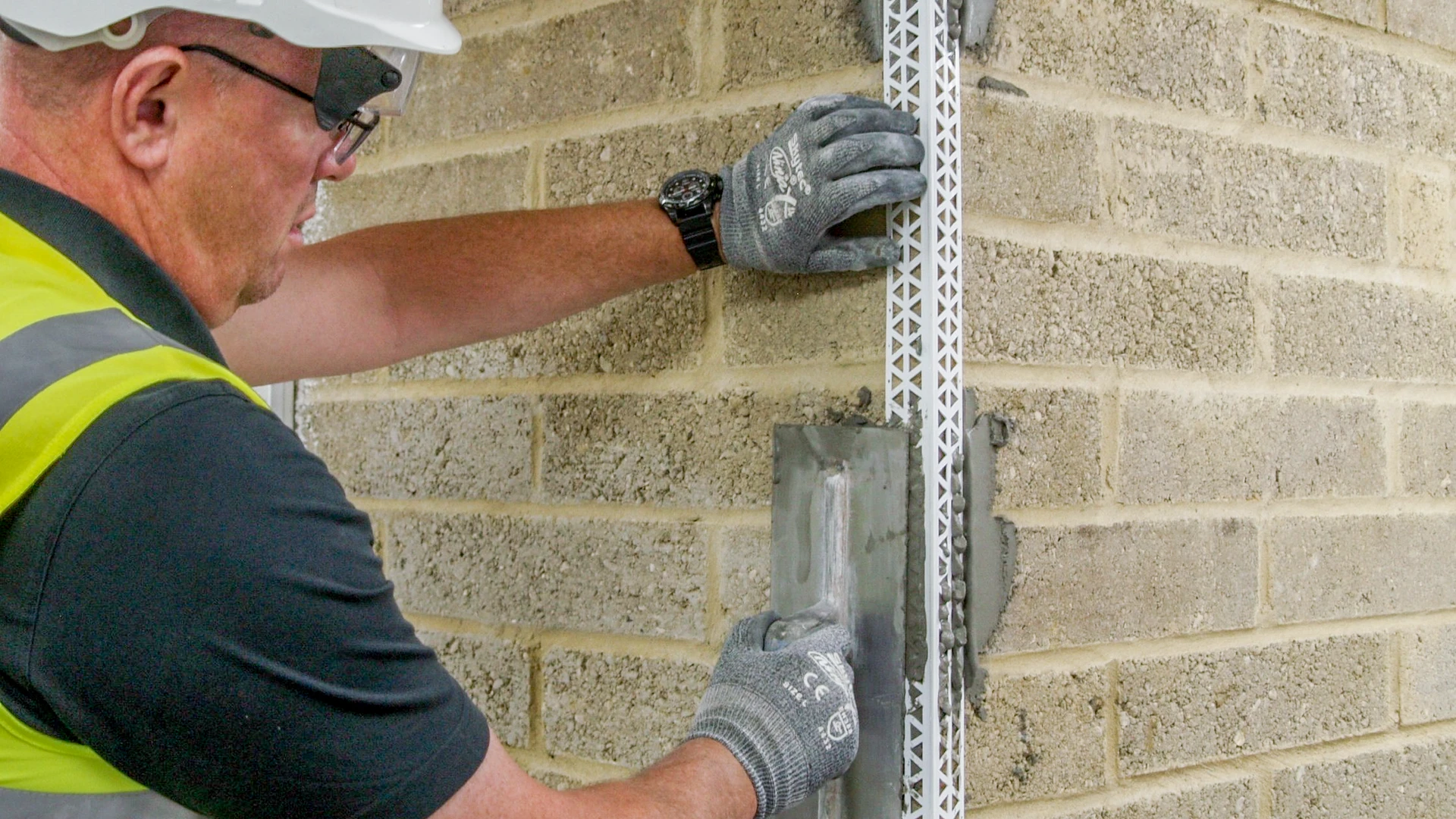
    Pick up the adhesive using your trowel and apply dabs of it to the substrate. To attach corner render beads, it’s best to use a corner trowel with a 90° angle to achieve a smooth and accurate finish.

    The dabs you apply should be at least 300mm apart, and 100mm x 40mm x 15mm in size. 
     

  • Step 4

    Fix beads

    Check that your render beads are in perfect condition and then cut to size using tin snips. 

    To fix the render bead, press it into the substrate and bead adhesive using your trowel to apply pressure. Once it’s fully embedded, step back and make sure it’s correctly aligned using a spirit level. Adjust it if you need to. 

    Remove any extra bead adhesive and smooth over using your trowel. 
     

  • Step 5

    Curing

    Once the render bead has been attached, it will set in as little as two hours. This can vary slightly depending on the type of substrate and conditions. You can then apply your render on the same day.

    Follow the manufacturer's instructions for the best results.   
     

Want to know more?

Find out more about different types of render beads and tips on how to apply them in our handy blog.

To learn more about our innovative weberend bead adhesive, visit the product page, contact us, or visit your local Weber stockist:

Find your local Weber stockist →   Contact us →

Click Compare to help you choose the right product for your project, if you need further assistance please email [email protected]

Compare